





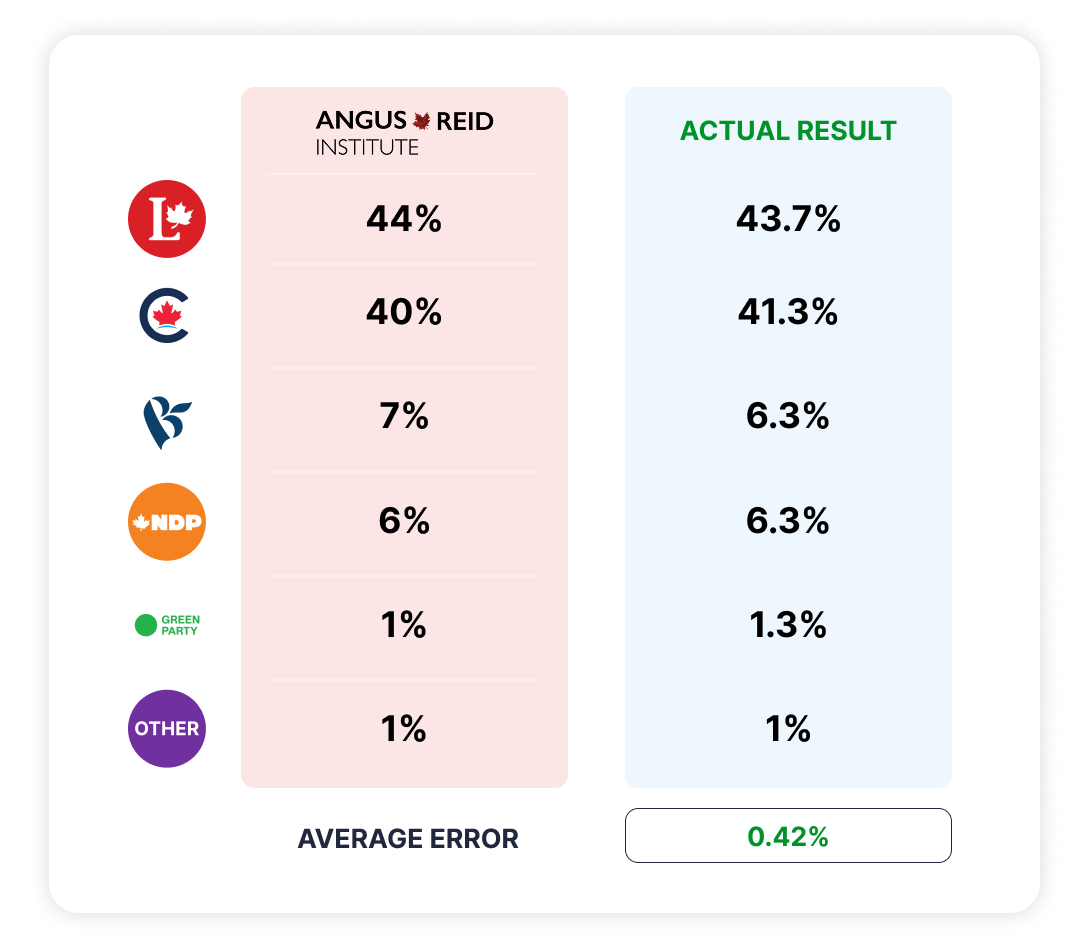
As votes were counted in this week’s federal election, one thing became clear: the Angus Reid Institute’s polling program delivered one of the most accurate forecasts of the campaign—not just nationally, but provincially, too.
Their final projection had the Liberals at 44% and the Conservatives at 40%. The result? 43% and 41%. A statistical bullseye.
In British Columbia and Quebec, their regional numbers matched the final tallies almost perfectly. In the Prairies, the Conservatives performed slightly better than projected, but still within the range of our forecasted lead. And while our projection for Ontario slightly underestimated the Conservative share (especially in the 905 region), the overall accuracy of our model stood firm.
These results are not just luck—they are the product of two decades of methodological evolution.
A rich heritage of nailing it every time
More than twenty years ago, facing rising refusal rates and an increasingly skeptical public, Angus made a decisive shift away from traditional polling methods. Participation in conventional polling had collapsed, with non-response rates exceeding 90%. Live interviewers and robo-calls were increasingly seen as intrusive. The writing was on the wall.
That shift was rooted in the belief that research could—and should—be more reflective of how people actually live and communicate. With the right investment and rigour, online polling could move beyond novelty and become the gold standard.
With that, the notion of the Angus Reid Forum was born. By building a large, representative of double opt-in respondents—people who actively choose to participate— Angus created a research infrastructure that delivers meaningful, reliable insights at scale. Respondents can engage on their own time, from their own devices, in surveys that offer context through images and video. Most importantly, the resources are directed toward growing and maintaining representative panels, not call centres. Layering on top of that, we introduced Survey Sentinal; an advanced algorithmic system specifically designed to identify and eliminate AI-generated or fraudulent survey responses. This innovative tool ensures that the people taking our survey are who they say they are. The result, is cleaner, more reliable data. And in this specific instance… accurate poll results.
Critics often point to the lack of a traditional margin of error in online polls. While that’s technically correct—because respondents are drawn from a panel rather than a truly random sample—the reality is that no poll today should confidently claim a traditional margin of error. Response rates are simply too low. In today’s polling environment, performance should be measured not by outdated models, but by results.
Judged by the Scorecard
In election polling, there are two standards: picking the winner, and estimating the vote share with precision. The Angus Reid Institute has delivered on both fronts.
Across dozens of major elections, our accuracy in projecting the winning party is in the high 90s. Our average variance across all parties is less than three percentage points. In many incases, including the most recent election, we were within one point of the final result. In some cases, our margin has been wider—but our forecasted winners still correct.
Looking Ahead
With every campaign, we sharpen our approach. We recognize the need for continued investment in our panel—especially in fast-changing regions like suburban Ontario—and we remain committed to transparency and accountability in our results.
This federal election reinforces what Angus has long believed: engaging verified panelists, with time tested methods and rigorous analysis delivers result you can count on.
Recommended
Understanding the trade-offs shaping Canada’s energy debate
When Canadians think about energy, many don’t start from a fixed position. Angus Reid’s latest national study found the largest group takes a balanced, case-by-case approach. The largest group of respondents (39%) described their views as balanced or...
By the time we ask, the moment has already changed
As Jennifer Reid, co-CEO of Rival Group, noted during our recent webinar, “Memory rewrites emotion.” Over time, people forget details and reinterpret experiences. Frustration softens, excitement fades and the small moments that seemed noticeable while...
AI Is Everywhere in Daily Life – That Doesn’t Mean Canadians Trust It
In our latest wave of the Canadians and AI tracker, 70% of Canadians say they have used AI tools in the past three months. That number has held steady since late 2025, but the behaviour underneath it is shifting. More Canadians now report using AI daily, including a...
Web Summit Vancouver; Brands in uncertain times.
Recently, the CEO of his namesake company, the Angus Reid Group, took centre stage at the Vancouver Web Summit with the Global CEO of FCB, Tyler Turnbull. On the docket? Insights from their groundbreaking joint Citizen Consumer Research Study. What started as a...